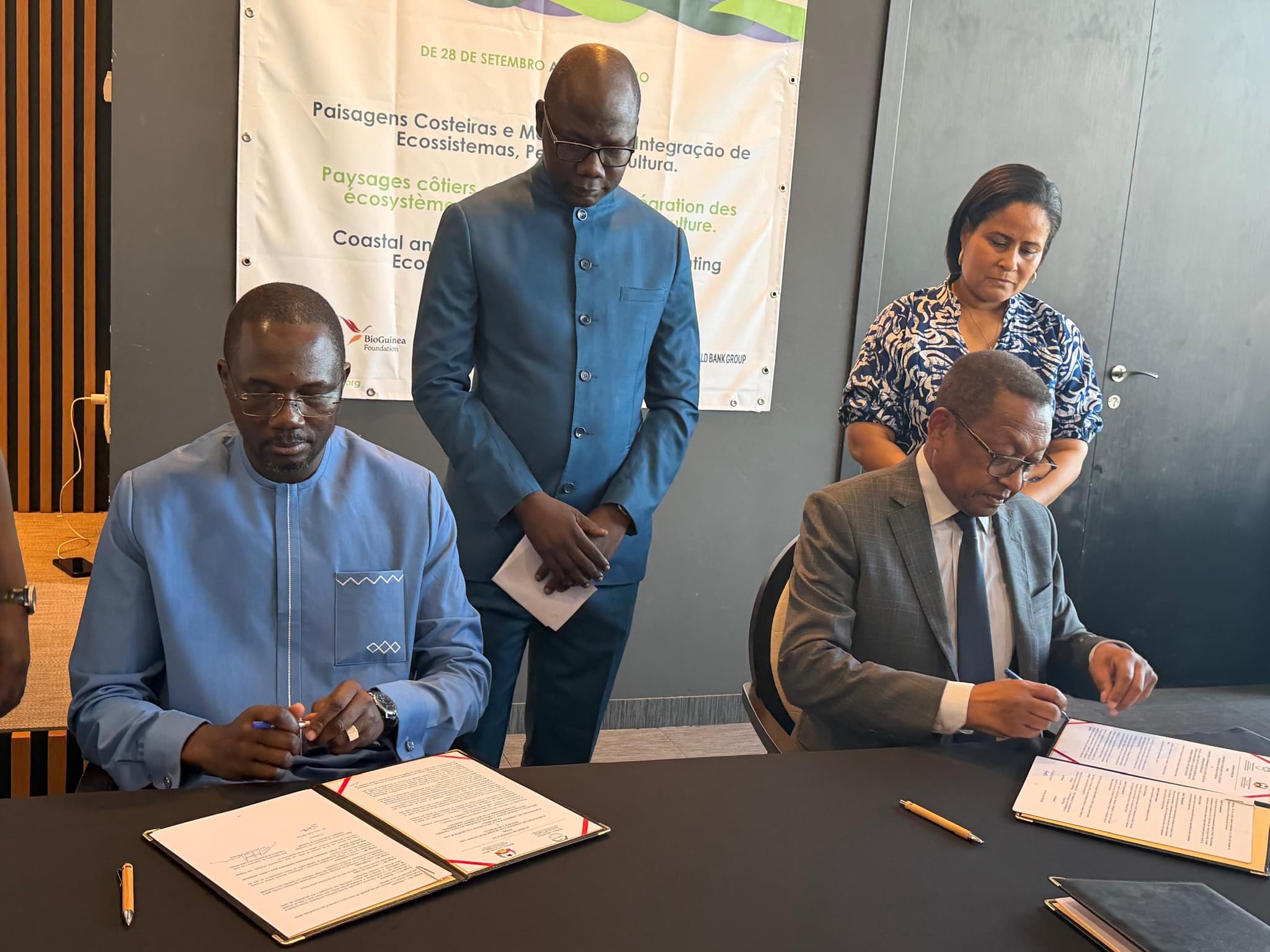
Environmental Cooperation: Senegal and Guinea-Bissau Agree to Establish a Transboundary Biosphere Reserve
Senegal and Guinea-Bissau have signed a cooperation agreement on the conservation and integrated management of the cross-border coastal area of Cacheu–Lower Casamance, with the ambition of establishing a transboundary biosphere reserve. The agreement was signed in Bissau on 30 October 2026.
The agreement was signed by Senegal’s Minister of Environment and Ecological Transition, Dr Aliou Gori Diouf, and his Bissau-Guinean counterpart, Dr Carlos Pinto Pereira. It aims to establish a legal and institutional framework enabling both countries to strengthen their cooperation in biodiversity conservation and the sustainable management of shared coastal and estuarine ecosystems.
The study area covers, on the Guinea-Bissau side, the Cacheu region and its associated natural areas, and on the Senegalese side, Lower Casamance, including several protected areas and marine protected areas. Under the agreement, both countries recognise that the coastal and estuarine ecosystems in this area form a continuous ecological unit, particularly through mangrove forests, bolongs (tidal channels), mudflats and habitats supporting several migratory species.
The cooperation aims to ensure the conservation of landscapes, ecosystems and species, promote sustainable economic and human development in the territories concerned, and strengthen research, ecological monitoring, environmental education and training. Senegal and Guinea-Bissau have agreed in principle to submit a joint transboundary nomination under UNESCO’s Man and the Biosphere Programme.
The two countries plan, in particular, to conduct a feasibility study, establish a joint zoning plan and develop a common management plan before preparing and submitting a single nomination dossier. The agreement also provides for the establishment of an institutional framework comprising, among other bodies, a Joint Ministerial Council, a Bilateral Management Commission, a Permanent Joint Secretariat, national focal points, and a Joint Scientific and Technical Committee.
Local communities will play a central role in this framework. Local consultation platforms will be established to involve neighbouring communities, professional organisations, local authorities, traditional and religious leaders, technical services and civil society organisations.
The cooperation also provides for coordinated surveillance of the proposed reserve area, including the possibility of joint patrols, particularly to combat illegal logging, unauthorised fishing, poaching and the illegal wildlife trade.
Both parties also intend to promote economic activities compatible with conservation objectives, including responsible small-scale fisheries, mangrove rice cultivation, oyster farming, beekeeping, and the processing and value addition of non-timber forest products.
A joint ecotourism strategy is also envisaged, with the aim of promoting the area’s natural and cultural heritage while ensuring that benefits are shared equitably with local communities.
Finally, the agreement provides for efforts to mobilise funding from technical and financial partners, international environmental funds and regional mechanisms, as well as exploring the establishment of a dedicated sustainable financing mechanism for the future reserve or its integration into an existing trust fund.
The roadmap provides for the establishment of the technical framework in the first quarter following the signing, a feasibility study within twelve months, territorial consultations within eighteen months, and the adoption of the joint zoning and management plans within an indicative timeframe of twenty-four months.
The single transboundary nomination dossier is expected to be submitted to the Secretariat of the Man and the Biosphere Programme within an indicative timeframe of thirty months following the signing of the agreement.